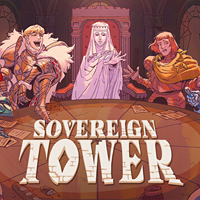
REVIEW | SOVEREIGN TOWER | WHEN FAILURE CHANGES THE STORY
A newly crowned ruler sits before a procession of worried citizens, demanding nobles, foreign representatives and eccentric knights, each convinced that their problem should become the kingdom’s immediate priority. One request may involve trade, another a dangerous creature, while the next could begin as an absurd inconvenience before developing into a political crisis. Sovereign Tower rarely gives its monarch enough information to guarantee the correct answer, and that uncertainty is precisely what makes its combination of narrative RPG, court management and time manipulation so effective. Developed by WILD WITS GAMES and published by Curve Games, the single-player PC release places the player in control of a magical tower, a growing kingdom and a Round Table filled with heroes whose talents are matched by fears, rivalries and considerable egos. Knights must be recruited, equipped and assigned to quests, public opinion must be balanced across different social groups, and decisions made during royal audiences can permanently redirect lives and alliances. When the result becomes unbearable, a demon hidden beneath the tower offers the ability to return to an earlier moment with knowledge preserved from the discarded timeline. What initially looks like a convenient method of correcting mistakes gradually becomes the game’s central moral and mechanical problem.
a crown built from daily decisions
Each day follows a clear rhythm without becoming entirely predictable. The Sovereign receives petitioners, responds to political and personal problems, manages available resources and then prepares knights for quests generated through those interactions. Decisions influence how commoners, nobles, merchants, scholars and other rulers perceive the crown, while some options require sufficient money, reputation or knowledge before they become available. Sovereign Tower works because these choices rarely feel like isolated dialogue questions. Refusing one demand may preserve the treasury but weaken a relationship needed later, while supporting a popular proposal can create consequences that only become visible several days afterward. The writing moves easily between absurd medieval comedy and genuine danger, filling the court with memorable personalities instead of faceless resource providers. Some situations are openly ridiculous, but the characters remain sufficiently well defined for their successes, disappointments and occasional deaths to matter. The humour sometimes sits too close to serious events and weakens their emotional impact, yet the game generally understands that its strange court is more interesting when laughter does not make every consequence harmless.
knights are people before they become statistics
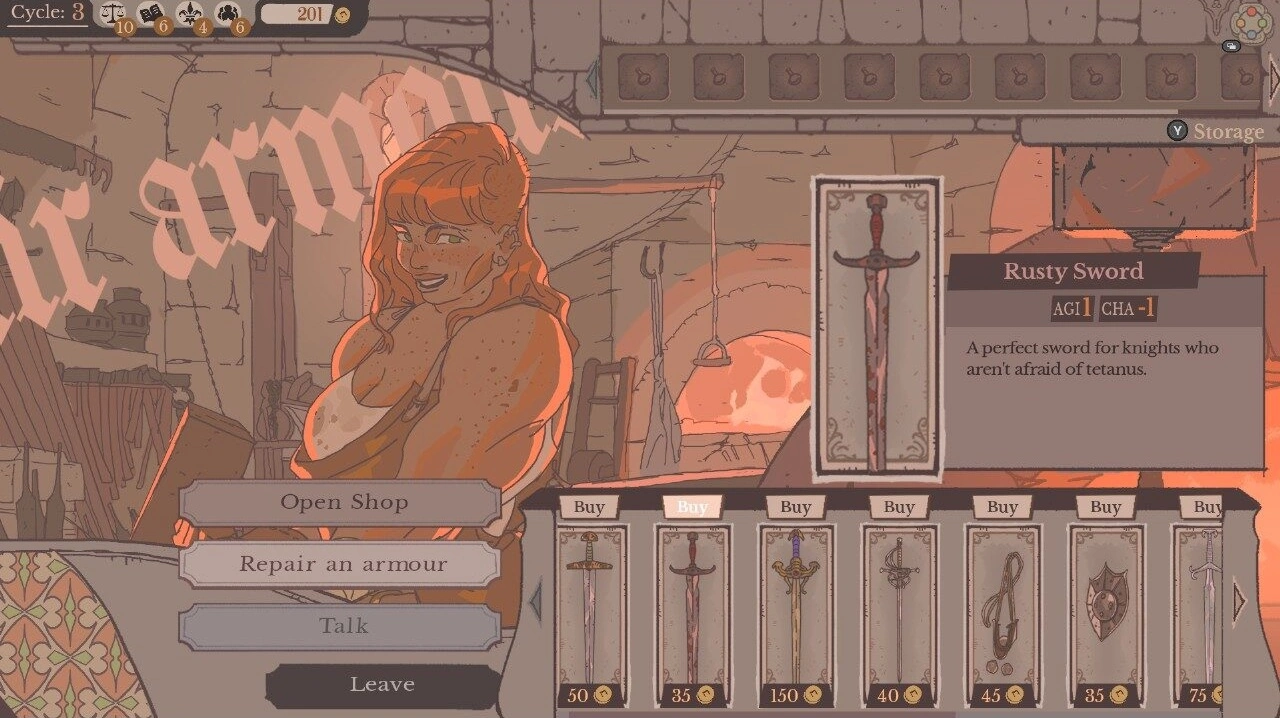
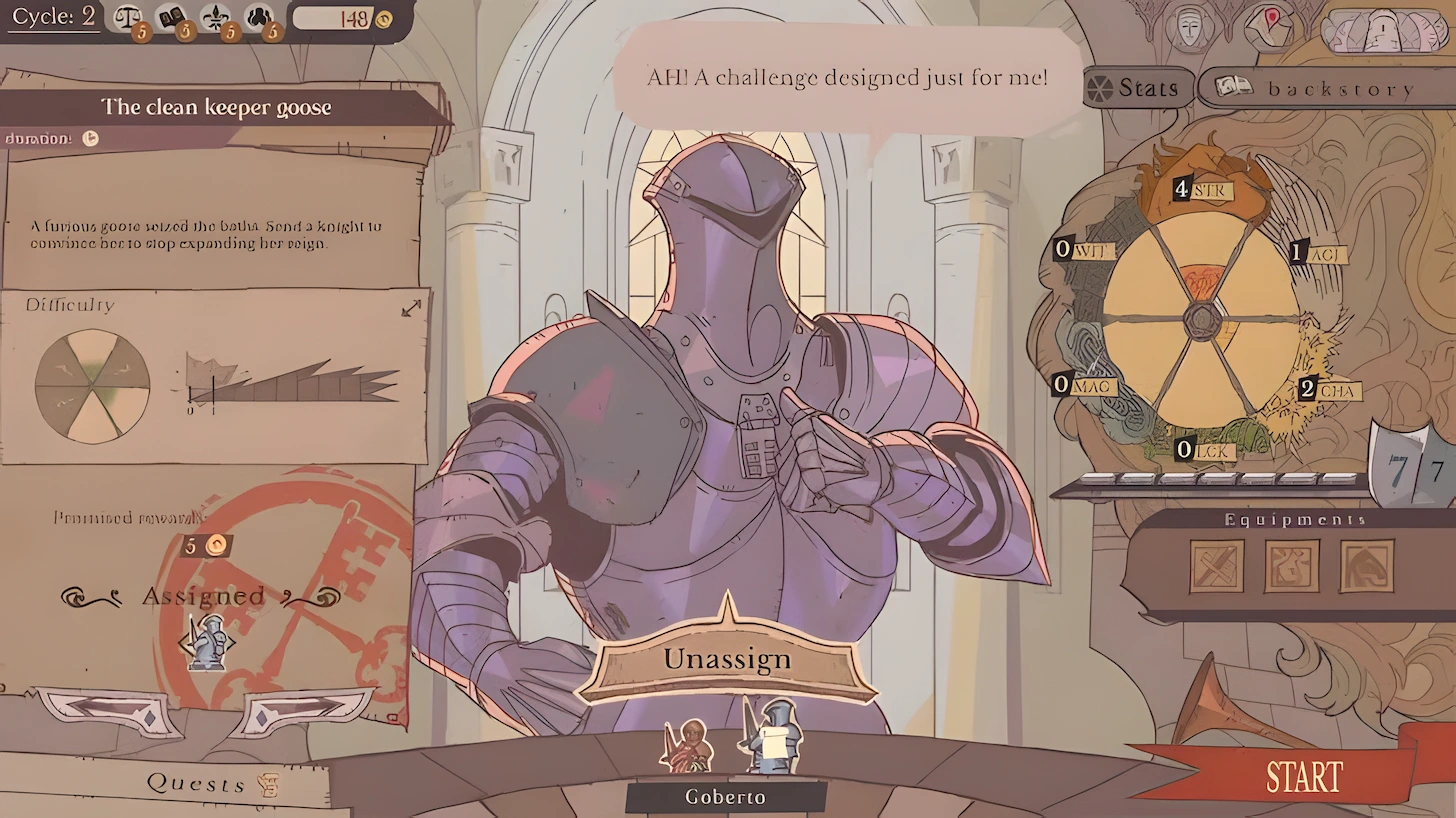
Quest assignment provides the main management puzzle. Every mission tests a particular combination of abilities such as strength, agility, magic, luck, charisma and wit, but the complete requirements are not always revealed in advance. Knights also possess individual traits, preferences and fears capable of modifying their effectiveness or satisfaction. A powerful fighter may appear ideal for a dangerous forest mission until the player learns that darkness or hunting causes serious problems, while a seemingly weaker knight may succeed because the assignment suits a hidden preference. Equipment, magical items and other preparations can strengthen specific attributes, allowing the player to compensate for weaknesses or build specialists for particular types of work. This creates more involvement than simply comparing one large rating against a mission difficulty number. The player gradually learns who these people are, how they react and which assignments they are likely to resent even when capable of completing them. Hidden information can occasionally feel restrictive, especially when an important result depends on a trait that was impossible to anticipate, but it also supports the central fantasy of ruling an unpredictable court rather than operating a perfectly transparent spreadsheet.
failure creates the strongest stories
Sovereign Tower is at its best when an apparently reasonable decision produces a result the player did not intend. A knight may fail, lose confidence, become injured or disappear from a later storyline. A diplomatic choice can close one opportunity while opening another, and relationships created through several days of careful decisions may collapse because of one poorly understood request. The game does not consistently label choices as morally correct or strategically optimal, making it difficult to approach the kingdom as a puzzle with one perfect solution. This gives failure narrative value. A disastrous result may reveal information that becomes useful later, introduce a new character or expose motives that would otherwise remain hidden. The temptation to reload or seek the safest route remains strong, but Sovereign Tower repeatedly demonstrates that the most interesting version of the kingdom is not necessarily the cleanest one. Some players may still find the repeated daily structure too familiar after the management loop is fully established, particularly when audiences, preparation and quest assignment begin following the same broad order. Strong writing and changing consequences prevent the repetition from becoming severe, but the underlying rhythm never disappears completely.

rewinding time destroys as much as it repairs
The demon beneath the tower transforms the familiar idea of reloading a save into an actual part of the world. When the Sovereign returns to an earlier point, knowledge from the abandoned timeline remains available, potentially unlocking new dialogue choices, exposing a hidden threat or allowing a death to be prevented. This is not a free correction. Changing one event also erases everything that happened because of it, including beneficial relationships, discoveries and characters who may only appear in that particular version of history. Saving one knight can remove the investigation that previously revealed another secret, while avoiding a political disaster may eliminate an alliance formed during the recovery. The mechanic therefore creates a persistent question: is the player improving history or merely replacing one imperfect timeline with another? Replaying part of the game after a rewind can become tedious, especially when the desired alteration occurs several events before the current point, but the knowledge-based dialogue options prevent the system from feeling like ordinary repetition. The demon’s eagerness to encourage further interference also gives every correction an uncomfortable atmosphere. Sovereign Tower does not treat time manipulation as an unlimited convenience; it treats it as a powerful habit whose cost may remain invisible until much later.

a kingdom with personality but limited visual weight
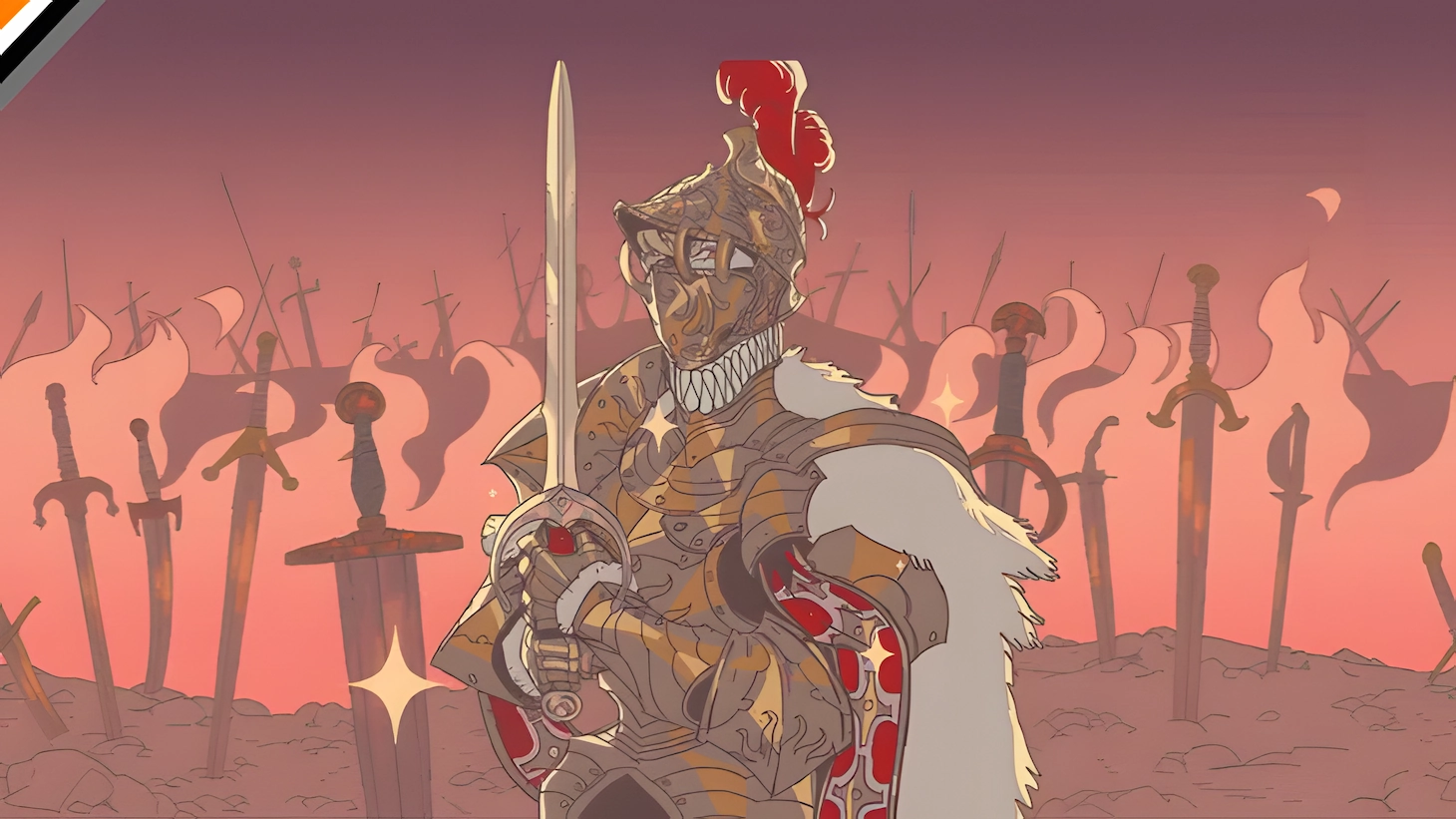
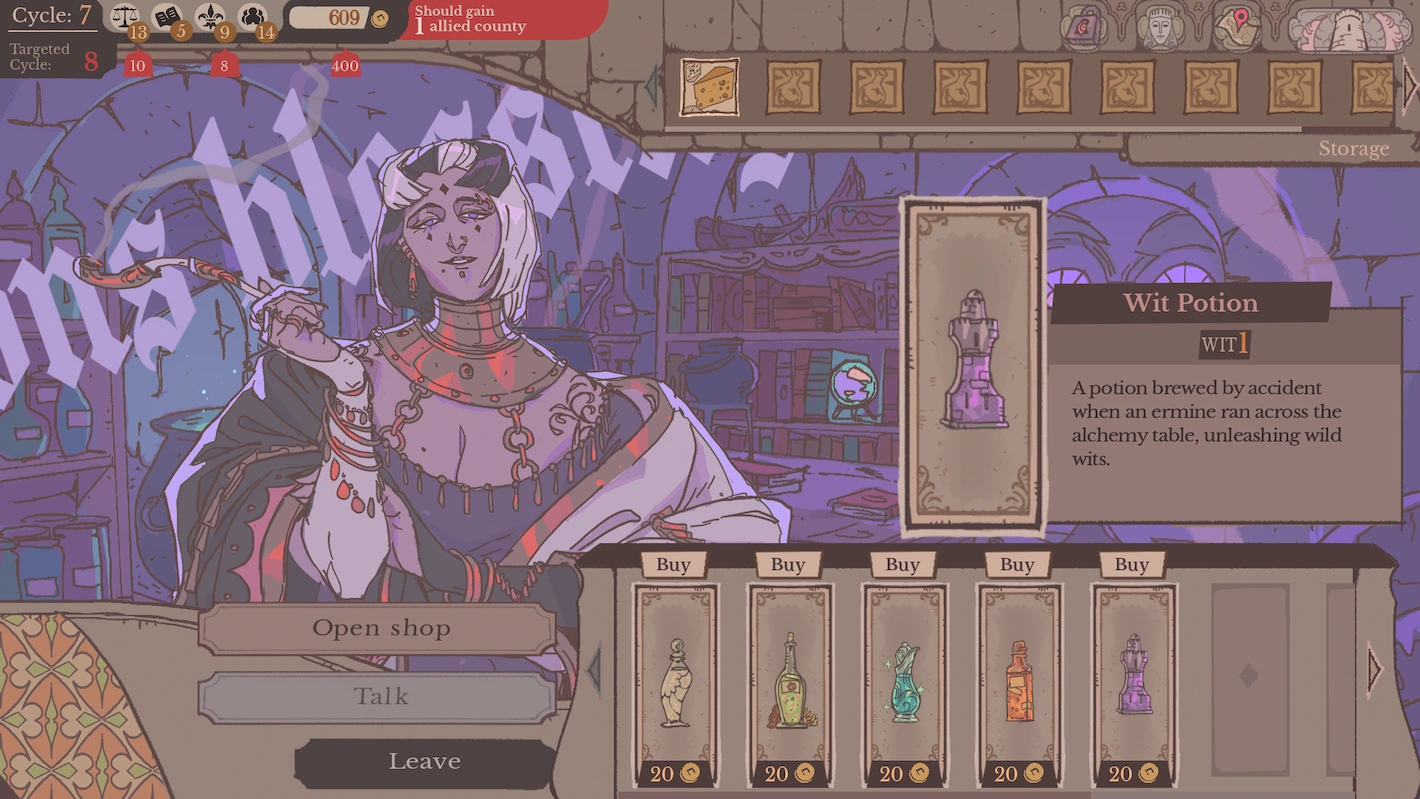
The hand-drawn presentation gives Sovereign Tower an immediate storybook identity. Characters resemble figures pulled from a medieval manuscript and reworked through a modern graphic-novel style, with exaggerated faces and clothing that communicate personality before a conversation begins. The designs fit the strange mixture of Arthurian fantasy, contemporary humour and political drama, while the relatively still scenes allow the writing and choices to remain central. However, the game often looks too pale. Characters, rooms and interface elements frequently occupy a similar range of softened colours, reducing separation between foreground and background and giving some scenes a washed-out appearance. Stronger shadows, deeper neutral tones or a more varied colour-grade treatment could have increased contrast without sacrificing the illustrated aesthetic. This is not a demand for bright saturation or a completely different art direction. The existing style simply needed slightly more visual depth and stronger tonal definition. The absence of full voice acting places additional pressure on the text and static character frames, although the writing is generally strong enough to carry extended conversations.
expansion gives the tower a visible history
The tower is not merely a menu used to move between audiences and quests. New annexes and upgrades gradually expand its practical role, while equipment, supplies and relationships support increasingly complicated decisions. This physical development gives the reign a visible sense of progress, complementing the less tangible changes occurring within the court. Leadership styles can also emerge from repeated decisions, rewarding consistent behaviour with new dialogue possibilities rather than reducing the Sovereign to a fixed moral alignment selected at the beginning. The system encourages role-playing without demanding that every ruler become purely benevolent or tyrannical. A practical monarch can support commoners in one dispute, protect the nobility in another and make an openly selfish decision when the kingdom’s survival appears threatened. Sovereign Tower is not a vast economic simulation, and players expecting detailed taxation, military logistics or territorial administration may find its kingdom management more narrative than systemic. Its strength lies in connecting resources, character relationships and court decisions closely enough that each reinforces the others.

replayability comes from curiosity rather than completion
A first playthrough can reveal a substantial story, but Sovereign Tower constantly suggests that entire characters, conversations and outcomes remain hidden behind different assignments and timelines. The rewind mechanic allows some alternatives to be explored within the same reign, yet it cannot preserve every beneficial consequence simultaneously. This makes another playthrough attractive not because the game demands exhaustive completion, but because unresolved questions remain attached to recognizable people. What would happen if a particular knight received greater attention? Could a disaster be prevented without sacrificing the relationship created by it? What changes when the demon is ignored completely? The game’s limited scale helps this structure because returning to the beginning is less intimidating than restarting a massive strategy campaign, while the density of branching events gives familiar days new meaning. One reviewed playthrough lasted approximately sixteen hours with frequent rewinding, though completion time can vary significantly depending on how deeply players explore alternate paths. The game’s Metascore currently stands at 86, but that figure is based on only four critic reviews, so it should be treated as an encouraging early reception rather than a stable industry-wide consensus.