PREVIEW | NO LAW | NO RULES, ONLY CONSEQUENCES
A former soldier waters the plants inside his apartment while neon light slips through the windows and Port Desire continues making noise somewhere beyond the walls. Grey Harker has already survived the battlefield, returned home with injuries that nearly killed him and decided that violence no longer deserves a place in his life. The city disagrees. When trouble arrives at his front door and takes something that belongs to him, Grey is pushed back toward the military instincts and modified equipment he hoped to leave behind. NO LAW is a single-player, first-person open-world shooter RPG from Neon Giant, the Swedish studio behind The Ascent, and its central promise is not simply a larger cyberpunk playground viewed from a different camera. Port Desire is being constructed as a dense, responsive city where exploration, relationships, stealth, aggressive combat and player-selected stories can unfold without one rigid path controlling every visit. The project is in development for PC, PlayStation 5 and Xbox Series X/S, with no confirmed release date currently attached. KRAFTON describes it as a story-rich cyber-noir experience built around player agency, while Neon Giant wants the city to remember actions and allow different players to leave with meaningfully different versions of Grey’s story. That ambition gives NO LAW immediate weight. Plenty of futuristic cities advertise freedom, but Port Desire is attempting something more difficult: allowing the player to decide which stories matter, then making the world acknowledge how those stories were handled.

grey harker wanted a quiet life
Grey is not introduced as an inexperienced outsider waiting for the player to transform him into a capable fighter. He is already a seasoned military veteran with the training, physical modifications and practical knowledge required to survive Port Desire’s criminal networks. The tension comes from his attempt to stop using those abilities. His apartment, plants and quieter routines are important because they establish something worth protecting before the action begins. Neon Giant has spoken about balancing harsh urban violence with warmer courtyards, ordinary residents, jazz, greenery and moments that do not treat cyberpunk existence as permanent misery. That contrast could give Grey more personality than the standard revenge-driven antihero. A city feels more dangerous when it contains normal life capable of being damaged, and violence feels more consequential when the protagonist has already decided he is tired of it. The official premise still pushes Grey toward taking back what was stolen, but NO LAW’s nonlinear structure may allow the player to determine what kind of man returns to the streets. He can approach conflicts through stealth, direct assault, unusual technology or manipulation of the surrounding environment, while his decisions affect alliances and later outcomes. A fully peaceful playthrough does not appear to be the intended design, but the difference between calculated force and uncontrolled destruction could become central to Grey’s identity. The strongest version of the story would not ask whether he can win another war. It would ask how much of the life he rebuilt remains after he starts behaving like a soldier again.
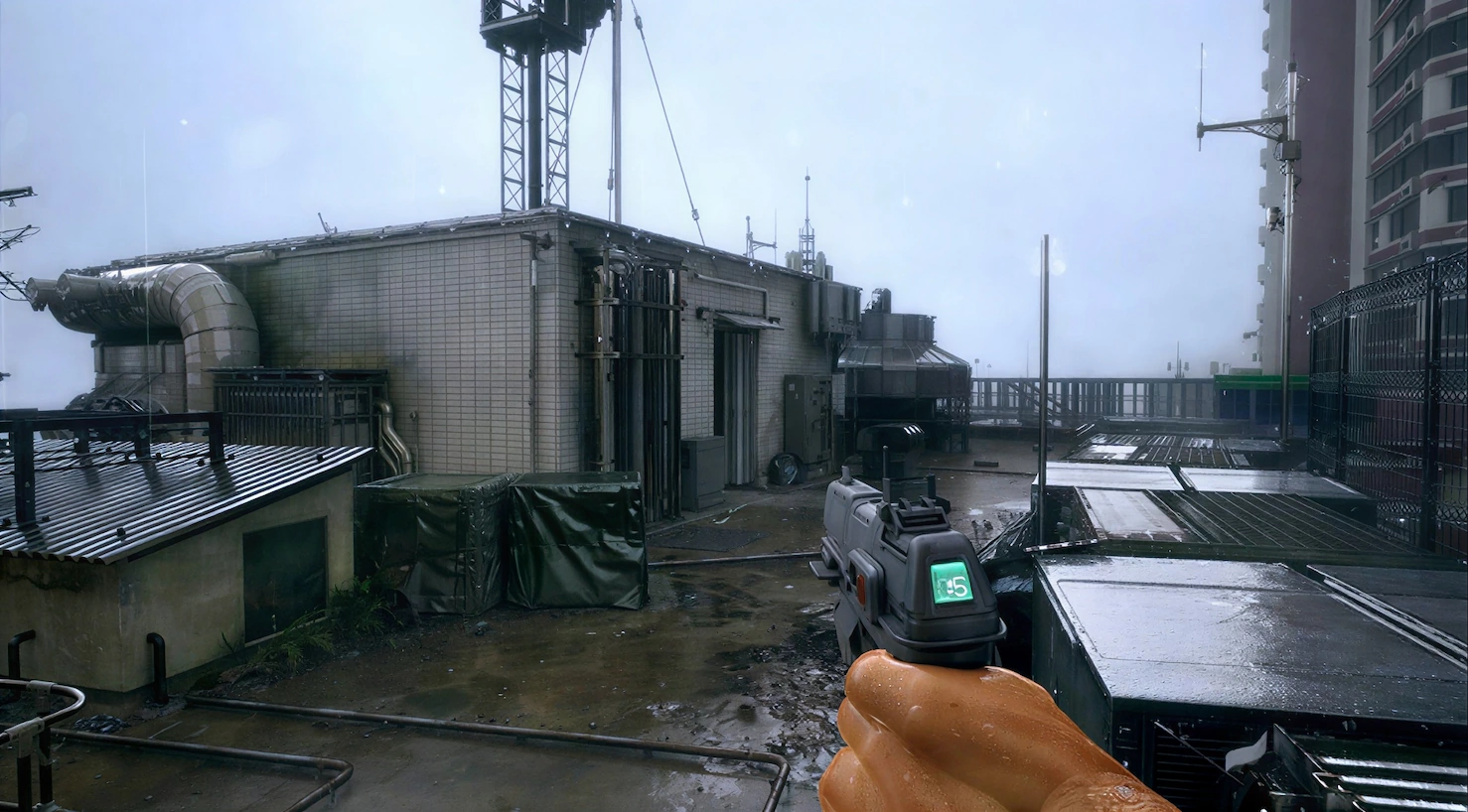
port desire values density over scale
Neon Giant is deliberately resisting the idea that every new open world must be larger than the last. Port Desire is described through density over scale, with compact districts containing interiors, alternative routes, stacked spaces, shortcuts and residents who give each area a recognizable function. Tight slums are expected to reward patience and vertical planning, wider roads allow firefights to spread into public spaces, and expensive interiors contain vents, service corridors and systems that can be manipulated. This matters because scale is often the least interesting measurement of a city. A district becomes memorable through how buildings connect, which entrances remain hidden, what people do there and how one action changes the next visit. NO LAW wants players to move through environments rather than merely across them. A target may be reached from the street, through an upper floor, along a maintenance route or by changing the conditions around the building before entering. Neon Giant’s earlier work already demonstrated an unusual talent for environmental detail, and the shift from The Ascent’s isometric viewpoint to first person places that detail directly around the player. The danger is that Port Desire becomes visually dense but mechanically selective, with only a limited number of prepared locations offering genuine interaction. Handcrafted clutter is not the same as systemic depth. The city must remain responsive beyond the exact rooms highlighted during demonstrations, and its districts need practical differences rather than cosmetic identities. Still, the decision to make a smaller city behave more convincingly is far more promising than another enormous map where most doors exist only as decoration.
light, sound and architecture become weapons
NO LAW’s combat combines firearms, military upgrades, science-fiction tools and environmental manipulation, but the most interesting details concern how enemies understand the space around them. Players can shoot out lights and plunge an area into darkness, with opponents reacting to changes in visibility, shadow and sound rather than continuing through a fixed encounter script. That opens the possibility of creating stealth opportunities dynamically instead of searching only for the route level designers clearly marked as quiet. A bright corridor can become cover, noise can redirect attention and vertical architecture can provide another angle before a fight begins. Direct combat remains a major part of the experience, and Neon Giant describes it as visceral and entertaining rather than relentlessly grim. The reveal material suggests heavy physical feedback, close-range aggression, large kicks and technology capable of turning ordinary shootouts into controlled chaos. Yet player agency will depend on more than carrying several tools. Enemies need to search intelligently, communicate changing conditions and adapt when the player repeats one successful method. If extinguishing lights always creates the same predictable reaction, an apparently systemic feature becomes another reusable trick. Weapon upgrades and skill trees face a similar risk. Statistical progression should support different approaches without reducing Grey’s effectiveness to a collection of percentage bonuses. NO LAW looks strongest when abilities interact with architecture, crowds and enemy perception, allowing a location to be changed before the first shot. Its combat will be judged not only by how powerful the weapons feel, but by whether the city gives the player enough reasons to avoid using them in exactly the same way every time.

one hundred players should create one hundred stories
Neon Giant describes NO LAW’s narrative as opt-in, meaning players can discover, accept, avoid or reorder many of Port Desire’s stories rather than receiving everything through one mandatory campaign sequence. The studio’s stated ambition is that one hundred players should leave with one hundred different user stories. That does not necessarily mean one hundred completely separate plots. It means relationships, encounters, loyalties and consequences should combine differently depending on where the player goes and what they decide deserves attention. This approach could solve a common open-world contradiction: games claim to offer freedom while filling the map with activities that behave like assignments waiting patiently for the protagonist. Port Desire may instead allow events to exist independently, asking the player to intervene without guaranteeing that every thread remains available forever. Characters could remember earlier treatment, gangs could respond to disruption and decisions in one district could alter the tone of another. The concept is powerful, but it is also the area where marketing language requires the most caution. Reactive narratives are expensive, difficult to test and easily reduced to a few dialogue changes surrounding an otherwise fixed structure. NO LAW must demonstrate that opting out produces consequences rather than simply removing content, and that different orders of play create more than slightly altered conversations. The absence of multiplayer is useful here because the entire simulation can be built around one player’s world state. Neon Giant does not need to synchronize Port Desire between several people; it needs to make one person believe the city noticed them.