CLASSIC GAMES | THE ELDER SCROLLS V: SKYRIM | THE UNFORGETTABLE CLASSIC
A mountain path, a distant ruin and a column of smoke rising somewhere beyond the trees are often enough to redirect an entire evening. That is the real power of The Elder Scrolls V: Skyrim. Dragons, civil war, ancient prophecy and the return of the Dragonborn give the game its dramatic structure, but the strongest impression does not come from any single quest or battle. It comes from the feeling that the world continues in every direction and that the road chosen by the player matters more than the destination suggested by the journal. Skyrim turns uncertainty into invitation. A cave entrance may hide a forgotten tomb, a small village may lead into a local tragedy, and a journey toward one objective can quietly become several hours of exploration through places that were never part of the original plan. This freedom has always defined The Elder Scrolls, but Skyrim presented it with unusual clarity. Its northern province feels broad without becoming emotionally empty, harsh without becoming visually monotonous and mysterious without depending entirely on scripted revelation. More than a decade after release, that sense of stepping into a world rather than entering a sequence of levels remains the game’s defining achievement.

the road is the real quest
Skyrim begins with urgency. The player is a prisoner, an execution is interrupted by a dragon, and the opening immediately establishes that something ancient has returned to a province already divided by war. Yet the game becomes itself only after the player leaves Helgen and reaches the open road. Riverwood may appear to be the obvious destination, but the surrounding landscape is already making competing offers. A standing stone waits near the river. A mine sits beside the path. Wolves move through the trees. Snow-covered mountains dominate the horizon, and ruins are visible long before the player knows what they contain. The main quest is present, but it does not control the rhythm. That distinction is central to the Elder Scrolls identity. Many open-world games provide freedom by placing activities across a large map, but Skyrim creates freedom through distraction, distance and uncertainty. The player often moves toward a place because it looks interesting rather than because a marker has assigned it value. The world encourages curiosity before it provides explanation. A symbol appears on the compass, but the game rarely tells the player whether it represents treasure, danger, history or an encounter that will change the direction of the journey. The strongest moments are therefore often unplanned. A trip to deliver a message can lead into a Dwemer ruin. A search for ingredients can reveal a dragon burial site. A storm may force the player toward an inn where a conversation begins another story. These events are not always mechanically complex, but their placement creates the impression of a world with depth beyond the player’s immediate purpose. Skyrim understands that exploration is not only movement through space. It is the constant possibility that the next hill will contain something worth remembering. The game rarely prevents the player from abandoning one objective for another, and it does not punish that lack of discipline. Wandering is not wasted time. Wandering is the structure.

a province built from contrast
The northern setting gives Skyrim a strong visual identity, but the province is more varied than its reputation for snow and grey mountains suggests. The tundra surrounding Whiterun is open and golden, giving the player long views toward farms, watchtowers and distant peaks. The Rift replaces harsh stone with autumn forests, lakes and warmer light. Falkreath is dark, green and crowded by trees. Winterhold feels exposed and broken, while the volcanic regions near Windhelm carry a different kind of desolation. Markarth is carved directly into ancient stone, and Solitude rises above the sea with the authority of an imperial capital. These regions create emotional contrast as well as geographical variety. Whiterun feels practical and central, a place through which roads and political tensions naturally pass. Riften carries corruption and secrecy into almost every corner. Windhelm is colder in both climate and social atmosphere. Solitude projects elegance, power and distance from ordinary hardship. Markarth feels old, vertical and permanently influenced by a civilization that disappeared long before its current residents arrived. The cities are smaller than those found in many later open-world games, but their identities remain distinct. Architecture, weather, local politics and recurring characters give them enough personality to be remembered as places rather than collections of services. The scale is compressed, but the atmosphere is concentrated. The wilderness between those settlements is equally important. Skyrim does not treat empty space as a mistake that must be filled every few seconds. Some journeys contain long stretches of wind, snow, trees and distant animal calls. Those quieter periods make the discovery of a ruin or settlement more effective. They also allow the player to feel the size of the province without requiring the map to become physically enormous.
the player arrives without a fixed life
The Dragonborn has a destiny, but Skyrim does not force a complete personality onto the character. Race, appearance, skills and loyalties are chosen or developed by the player, while the opening provides only the minimum required history. The character was caught crossing the border. Everything else can be imagined. This flexibility is one reason the game remains easy to revisit. A Nord warrior, Khajiit thief, Breton mage or Imperial mercenary can move through the same province while producing different priorities. The main narrative may eventually identify each of them as Dragonborn, but the hours before and between those revelations belong to the player. Skyrim’s skill system reinforces that freedom through use. Swinging a two-handed weapon improves the corresponding skill. Sneaking, smithing, enchanting, blocking and casting spells develop through repeated action. The player does not select a rigid class at the beginning and remain trapped inside it. A warrior can gradually discover magic. A thief can become an archer. A mage can begin wearing heavy armour because the world has pushed the character in an unexpected direction. This system is imperfect. Some skills improve more naturally than others, and efficient crafting can distort progression. Stealth archery became famous partly because it is extremely effective and partly because the game repeatedly rewards distance, concealment and patience. Yet the underlying idea remains powerful: identity is built through behaviour. The player becomes the character by doing things, not by selecting a permanent label. That gives Skyrim an unusual sense of personal development. The final build is often different from the one imagined at the beginning because the world has influenced the player’s habits.

combat is simple, but preparation creates identity
Skyrim’s combat is not the deepest part of the game. Melee exchanges can become repetitive, enemy reactions are limited and weapon impact often lacks the precision found in more focused action RPGs. The simplicity becomes most obvious during longer battles, where success may depend more on equipment, health and damage values than on complex technique. Yet combat supports a wide range of character fantasies. Sword and shield, two-handed weapons, dual wielding, bows, destruction magic, conjuration and stealth all offer recognizable approaches. The system is accessible enough that changing direction does not require mastering a completely new control structure. Magic is particularly important to the game’s identity, even when individual spell categories lack depth. Flames light dark ruins. Conjured creatures alter the balance of a fight. Restoration extends survival. Illusion can redirect enemies or avoid combat entirely. Alteration and enchanting allow players to shape characters around preparation rather than direct damage. Crafting adds another layer. Smithing, alchemy and enchanting can produce extremely powerful equipment, sometimes powerful enough to undermine the difficulty curve. However, these systems also allow the player to feel responsible for the character’s growth. A sword found in a chest is useful; a sword forged, improved and enchanted through several related skills feels personal. Dragon Shouts provide the game’s most distinctive combat and traversal ability. Fus Ro Dah became famous because it is immediately understandable, visually clear and capable of producing both tactical and ridiculous moments. Other Shouts affect weather, speed, time, movement and control. Their connection to exploration also matters, because learning them requires finding Word Walls hidden across ruins and mountains. Combat may not carry Skyrim alone, but it gives the player enough tools to develop a style and enough flexibility to change that style when the journey demands it.

the dungeons tell smaller stories
Skyrim contains a large number of caves, forts, tombs and ruins. Their layouts can become familiar, particularly after many hours, but the best examples contain small narrative details that reward attention. Journals, bodies, environmental damage and the position of objects can explain what happened before the player arrived. Nordic tombs provide the clearest recurring structure. Their ancient architecture, burial practices and Draugr connect exploration directly to the history of the province. Puzzle doors, Word Walls and hidden chambers give these spaces a ritual quality, even when the mechanical patterns repeat. Dwemer ruins offer a stronger contrast. Bronze machinery, geometric construction and artificial guardians create the feeling of entering a civilization whose technology does not belong to the world above. The disappearance of the Dwemer remains unexplained enough to preserve mystery, and the depth of their underground cities can make a short detour feel like a separate expedition. Falmer territory changes the atmosphere again. What begins as a conventional cave can descend into something darker, filled with evidence of adaptation, cruelty and isolation. These transitions help Skyrim avoid making every underground space feel identical. The game’s environmental storytelling is rarely subtle enough to require extensive interpretation, but it is effective at suggesting that locations existed before the player. Bandits occupy abandoned forts for practical reasons. Necromancers choose hidden spaces. Tombs contain cultural meaning rather than functioning only as treasure chambers. The result is a world where exploration often becomes archaeology. The player does not simply clear an area. The player discovers why the area exists and what happened to the people who used it.
quests range from ordinary to unforgettable
Skyrim’s main quest provides a clear heroic structure: dragons have returned, the player possesses a rare power, and the province faces a threat connected to ancient prophecy. It contains memorable locations and gives the Dragonborn a place within the wider mythology of the series. Yet the game’s reputation rests just as heavily on its faction stories, Daedric quests and unexpected local encounters. The Dark Brotherhood remains one of the strongest examples of Skyrim’s ability to shift tone. It begins with rumour and murder, then develops into a story about loyalty, decline and identity. The Thieves Guild gives Riften’s criminal world a larger structure, although its progression sometimes weakens the fantasy of being a thief by relying too heavily on dungeon-style missions. The College of Winterhold provides access to magical study and ancient danger, but its short advancement can make the player’s rise feel too rapid. The Companions offer a more traditional warrior path shaped by honour and a secret carried within the group. The civil war between the Empire and Stormcloaks gives the province political tension, but its execution is less complex than its premise. Both sides represent understandable arguments and serious flaws. The Empire offers stability while compromising under external pressure. The Stormcloaks fight for independence while carrying nationalism, resentment and exclusion. The conflict provides context to cities and characters, even when the battles themselves feel limited by the game’s technical scale. Daedric quests often provide the strangest and most memorable stories. Their moral tone is darker, their rewards are unusual and their outcomes can reveal the player’s willingness to serve powers that rarely deserve trust. These quests preserve the more disturbing side of Elder Scrolls mythology beneath Skyrim’s heroic surface. Smaller quests matter because they make the province feel inhabited by problems that have nothing to do with the Dragonborn. Families have disputes. Merchants disappear. Villages fear nearby threats. Priests, hunters, soldiers and criminals all have concerns that existed before the player’s arrival. Not every quest is equally strong, but the variety supports the illusion that the world contains more stories than any single character can complete.
modding turned skyrim into a platform
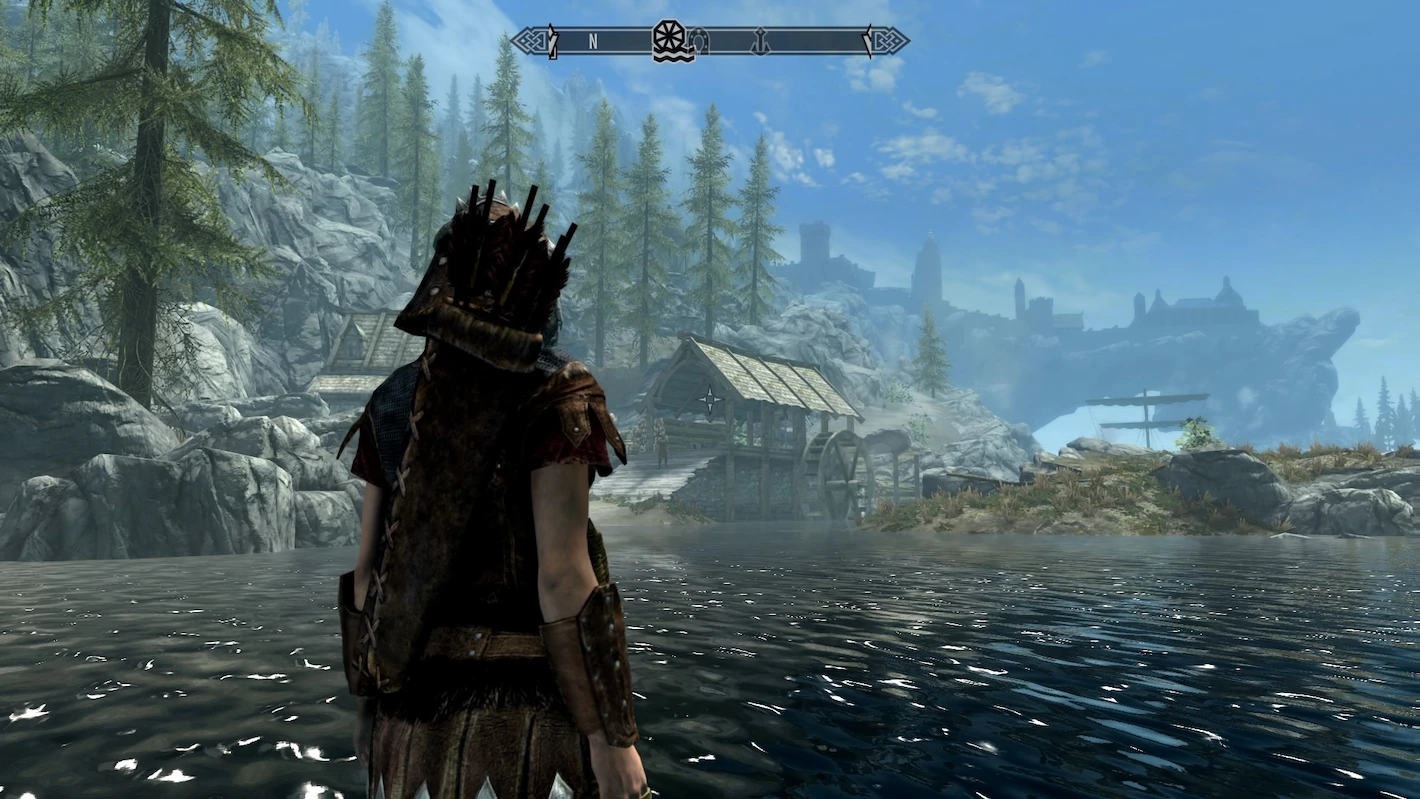
Skyrim’s original release was already expansive, but its life on PC became inseparable from modding. Community creators changed nearly every part of the game: textures, lighting, weather, combat, animation, interface, cities, quests, companions, survival systems and complete regions. Some players use mods to preserve the original experience while improving image quality and stability. Others transform Skyrim into a substantially different RPG. Combat can become faster or more tactical. Cities can grow. Roads can fill with travellers. Needs such as hunger, cold and fatigue can turn exploration into survival. New quest lines can add dozens of hours. This flexibility is one reason the game remained relevant across multiple hardware generations. Skyrim did not survive only because Bethesda repeatedly reissued it. It survived because the PC community treated the game as a foundation rather than a finished object. The Creation Kit gave players tools to understand and expand the world, while the game’s modular structure made experimentation relatively accessible. The results range from minor convenience changes to projects large enough to resemble independent productions. Modding also reveals what players value most about Skyrim. They rarely try to replace its central promise of open exploration. Instead, they deepen it. They make the world more believable, more dangerous, more populated or more responsive. The strongest mods do not reject Skyrim’s identity; they give that identity additional detail.
its imperfections became part of the memory
Skyrim is filled with technical oddities. Characters become trapped in objects. Physics behave unpredictably. Dialogue begins at the wrong time. Quest scripts can fail, and animation rarely reaches the standards of more tightly controlled games. These problems should not be romanticized. Bugs can damage progression, break immersion and force players to use console commands or reload earlier saves. The interface was clearly designed with controllers in mind and remains awkward on PC without modification. Inventory management becomes increasingly inconvenient as the character accumulates weapons, ingredients, books and crafting materials. NPC interaction can also feel artificial. Conversations occur too openly. Characters repeat lines until they become jokes. The world reacts to major achievements with inconsistent recognition. A legendary hero can still be treated as an unknown outsider by guards who have somehow missed every recent event. Yet Skyrim’s failures often exist beside moments of genuine magic. A dragon can interrupt an unrelated battle. A giant can launch an enemy into the sky. A companion may behave strangely during a serious quest. These events are not always intended, but they become personal stories. The game’s looseness creates instability, but it also creates surprise. A more controlled production would avoid many bugs, though it might also reduce the number of unexpected interactions that make each playthrough feel different. Skyrim’s reputation is not built on technical perfection. It is built on the belief that the world is broad enough to absorb imperfection and continue producing stories.
the strongest impression is freedom
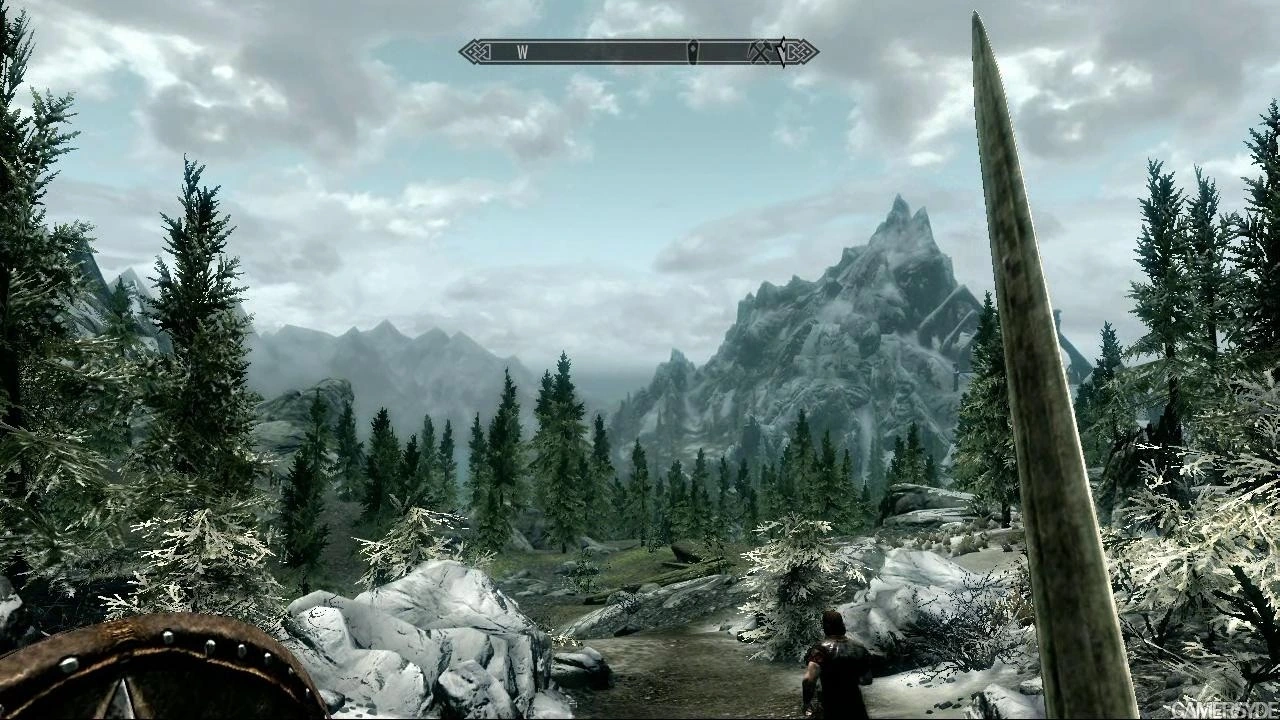
The most lasting impression Skyrim creates is not the defeat of Alduin, the choice between political factions or the completion of a guild storyline. It is the moment when the player looks away from the objective marker and chooses another direction. That freedom feels personal because it is rarely announced. The game does not congratulate the player for abandoning the intended route. It simply allows the decision and provides something worth finding. The mountain can be climbed. The ruin can be entered. The distant city can be reached long before the story sends the player there. The Elder Scrolls series has always understood that open-world freedom is more convincing when it exists inside the player’s imagination. Skyrim provides the geography and systems, but the player provides the purpose. One character may spend days hunting, trading and improving a home. Another may pursue magic. Another may ignore the main quest while exploring every visible cave. This creates a relationship with the world that is difficult to reproduce through linear storytelling. Skyrim is remembered not only as a sequence of authored events but as a place in which players formed routines. They knew the road from Whiterun to Riverwood. They returned to particular houses. They stored equipment, selected companions and developed preferred routes across the province. The world gradually became familiar without becoming completely exhausted. Even after dozens of hours, an undiscovered location could remain beyond a mountain or inside a valley previously crossed from another direction. That is Skyrim’s greatest success. It allows exploration to become ownership. The player does not own the world because every icon has been completed. The player owns it because the roads, settlements and landscapes have become part of personal memory.
why skyrim became a classic
Skyrim became a classic because it offered scale without demanding a specific lifestyle from the player. It could be played for hundreds of hours, but it did not require that commitment before providing satisfaction. A short session could contain a completed cave, a new weapon or a journey between towns. A longer session could become an unpredictable chain of quests and discoveries. Its accessibility also mattered. The game simplified several systems compared with earlier Elder Scrolls entries, and some long-time players reasonably criticised the loss of attributes, spell creation and deeper role-playing structures. However, that simplification allowed a wider audience to enter the series without removing its central freedom. Skyrim arrived at a moment when open-world games were becoming dominant, but it did not feel like a product assembled from the conventions that later became standard. Its map was not only a list of activities. Its exploration felt less regulated, its character development more flexible and its world more willing to let the player become distracted. The soundtrack, art direction and environmental sound strengthened that identity. Jeremy Soule’s music moves between grandeur, loneliness and calm without constantly demanding attention. Wind, water, distant animals and footsteps often carry the quieter moments between battles. The northern landscape became immediately recognizable. Snow-covered mountains, pine forests, ancient stone and auroras created an image of fantasy that has remained influential even after technology moved far beyond the original release. Skyrim is not the deepest role-playing game, the most precise action game or the most technically stable open world. It became a classic because it made freedom feel natural. It gave players a province and trusted them to decide what mattered.