

KLASIČNE IGRE | PRINCE OF PERSIA: THE SANDS OF TIME | STILL WORTH REWINDING
Prince of Persia: The Sands of Time still has that rare kind of movement that makes an old game feel alive before the first big fight even begins. You notice it when the Prince runs along a wall, grabs a ledge, swings from a pole, lands with just enough weight, and continues forward like the room was built to be read through motion. A lot of games from the early 2000s feel trapped in their age now, either because their controls became too stiff or because their best ideas were later done better by others. The Sands of Time is different. It shows its age, of course. The camera is not always friendly, the combat repeats itself, and the whole thing carries that older action-adventure structure where the path is clearly designed around one intended rhythm. But that rhythm is exactly why it still works. The game has shape, purpose and elegance, and even today it feels like a focused adventure made by people who understood how powerful movement could be.
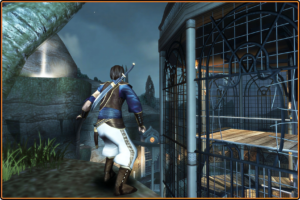
Released in 2003, The Sands of Time arrived at a point when third-person action-adventure games were still figuring out how to make 3D traversal feel natural. Platforming had already existed for years, but smooth cinematic movement through architectural spaces was still something developers were trying to solve. Ubisoft’s answer was not to make the biggest world or the most complicated combat system. The answer was flow. The Prince could run along walls, vault over gaps, swing from poles, climb, balance, slide, rebound, and move through rooms in chains of physical actions that felt clean when the player understood the space. This is the game’s central achievement. It made movement feel like a language, and the palace became the sentence the player had to read.
a palace built for movement
The palace in The Sands of Time is still one of the most important parts of the experience. It is not just a pretty fantasy location placed behind the gameplay. It is the gameplay. Every wall, ledge, column, trap and platform seems to exist because the Prince can do something with it. A room is not only a room. It is a route waiting to be understood. The player enters, looks around, spots a ledge, notices a pole, sees a wall that can be run across, and slowly the path starts to form in the mind before the hands execute it. That loop remains satisfying because it respects the player’s ability to observe. This is where The Sands of Time still feels cleaner than many larger modern games. It does not give you a huge map full of icons. It does not flood you with systems, upgrades, side objectives and crafting menus. It keeps the adventure focused. You move through dangerous spaces, solve traversal problems, fight when the game demands it, and continue deeper into a palace that slowly becomes stranger and more corrupted. That smaller scale helps the game. It gives every room more weight. You are not simply passing through content. You are learning how the space works, one wall-run and one jump at a time. There is also a kind of physical pleasure in the way the Prince moves. It is not realistic in a strict sense, but it is believable within the game’s fantasy logic. He has momentum, but not too much. He feels athletic, but not weightless. The animations connect well enough that movement becomes stylish without being purely decorative. When you perform a clean sequence through a room full of traps, the game gives you the feeling that you solved something with your body, not only with your brain. That is a different kind of satisfaction from simply finding the correct switch or solving a puzzle on a menu screen.

the dagger of time still makes sense
The Dagger of Time is one of the smartest mechanics of its era because it solves a gameplay problem and strengthens the story at the same time. In many older 3D platformers, one mistimed jump or awkward camera angle could punish the player harshly. The Sands of Time gives you a tool that turns mistakes into second chances without removing danger entirely. You fall, get hit, miss a jump or make the wrong move, and the dagger lets you rewind a few seconds. It feels generous, but not cheap. It gives control back to the player while keeping the pressure alive. What makes the rewind so effective is that it feels like it belongs. It is not just a checkpoint system hidden under a magical animation. The whole story is about time, consequence and regret. The Prince makes a mistake early in the game, and the rest of the adventure is shaped by that mistake. The ability to reverse small errors in gameplay mirrors the larger fantasy of wanting to undo something terrible. That connection between theme and mechanic is why the dagger still feels memorable. It is not only useful. It is meaningful. The rewind also improves the game’s pacing. Instead of stopping the player too often, it allows the flow to continue. A difficult trap section becomes less frustrating because one mistake does not always throw you back too far. A dangerous fight becomes less punishing because you can recover from one bad moment if you have enough sand left. The system encourages confidence. You try things. You move faster. You take a jump that might be risky because you know the game gives you a limited way to correct yourself. That is good design, and it still feels good years later.
a story told like a memory
The Sands of Time has a storybook quality that gives it a different flavor from many modern fantasy games. It is not overloaded with lore, factions, maps, political systems and endless explanations. It feels like a tale being retold, with the Prince himself framing the adventure almost as something remembered after the fact. That tone gives the game charm. It feels old-fashioned in a good way, like a fantasy adventure that understands mystery does not always need to explain every corner of the world. The Prince begins the story arrogant, impulsive and too impressed with himself. That matters because the disaster is not random. It comes from pride, curiosity and a bad decision. When the Sands of Time are unleashed and the palace falls into corruption, the adventure becomes more than a simple monster problem. It becomes a story about consequence. The Prince is not only trying to survive. He is trying to fix something he helped break. The writing is not subtle by modern standards, and some dialogue has that theatrical early-2000s tone, but the basic emotional structure still works. Farah is a major reason the story has warmth. Her relationship with the Prince is built on mistrust, irritation, cooperation and gradual respect. It is not written with the complexity of a modern character drama, but it has personality. The two characters give the adventure a human center, and their dialogue helps break the loneliness of the palace. The game is stronger because the Prince is not completely alone. Farah gives him someone to challenge him, distrust him, help him and remind him that the disaster has consequences beyond his own survival.


combat that does not age as well
The weakest part of The Sands of Time today is the combat. It was never terrible, and at times it still has style. The Prince can vault over enemies, strike from different angles, block, dodge and use the dagger to finish sand creatures. Early on, the combat feels like a natural extension of the acrobatic movement. It looks elegant, and it fits the fantasy of a fast, athletic hero fighting corrupted enemies inside a cursed palace. The problem is repetition. Encounters often last longer than they should, and the enemy variety is not strong enough to keep combat exciting throughout the whole game. After a while, many fights begin to feel similar. You enter a room, enemies appear, you deal with them using familiar patterns, then you move on to the better parts of the game. Combat gives the adventure danger, but it does not carry the same design confidence as the traversal. That difference becomes clearer when playing it today. This does not ruin the experience, but it does show where the game has aged. The platforming and room design still feel sharp because they are built on readable physical logic. The combat feels more limited because it depends on repetition and older animation priorities. A modern player may enjoy the atmosphere and movement but become impatient during longer fights. That is understandable. The Sands of Time is a classic, but it is not flawless, and its classic status should not require pretending that every part of it aged equally well.
the camera and old third-person friction
The camera is another reminder that this is a game from a specific period in 3D action design. Most of the time it works well enough, especially because the rooms are constructed with clear traversal routes. But there are moments where it becomes less helpful than it should be. A jump can feel slightly uncertain. A combat space can become tighter than the camera likes. A fast movement sequence can briefly make the player fight the view instead of the obstacle. These moments are not constant, but they exist. The reason they do not break the game is that the level design usually communicates well. Even when the camera is not perfect, the player can often understand where the route is supposed to go. The rewind also reduces frustration because a missed jump is not always a full reset. That does not excuse every camera issue, but it explains why the game remains playable and enjoyable. The Sands of Time has old friction, but it also has smart systems that soften that friction. In a strange way, those imperfections also make the game feel more handcrafted. Modern games often smooth every edge until the player barely notices the systems beneath the surface. The Sands of Time still feels designed room by room, challenge by challenge. You can feel the structure. You can feel the intended path. Sometimes that creates tension with the camera or controls, but most of the time it creates clarity. The game knows where it wants you to go and what it wants you to feel while getting there.
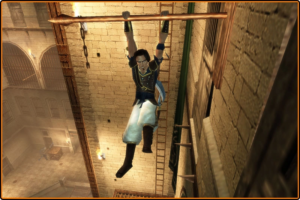
why the movement still matters
The movement in The Sands of Time matters because it helped change expectations for third-person action-adventure games. Wall-running and acrobatic traversal existed in different forms before, but this game gave them a clean cinematic identity. It made architecture feel interactive in a way that influenced later Ubisoft design and, indirectly, many action-adventure games that followed. You can draw a line from the Prince’s movement to later games built around climbing, parkour, vertical spaces and fluid navigation. But the game’s importance is not only historical. It is still enjoyable because the movement has rhythm. Many games are influential but not especially fun to revisit. The Sands of Time is different because its core loop still has pleasure. You see a route, attempt it, fail, rewind, adjust, and then complete it with style. That sequence remains strong because it is easy to understand and hard enough to feel rewarding. It is simple, but not shallow. There is also a kind of restraint here that feels refreshing now. The game does not need to constantly reward the player with loot. It does not need skill trees every few minutes. It does not need endless collectibles screaming for attention. The reward is often movement itself. Getting across the room is the reward. Surviving the trap is the reward. Reaching a new area of the palace is the reward. That sounds old-school, but it is also clean game design.
a visual style that still has charm
Visually, The Sands of Time is obviously old now, but it has enough art direction to survive beyond its technical limits. The palace has warm colors, soft fantasy lighting, ornate spaces, dangerous trap rooms and a sense of place that still comes through despite older textures and geometry. It does not look modern, but it has mood. That matters more than raw detail when looking back at classic games. The animations are also a big part of the visual identity. The Prince’s movement gives the game personality. Even when the environments show their age, the way he moves through them still sells the fantasy. A clean wall-run or pole swing can look better in motion than a technically sharper but less expressive animation from a newer game. The Sands of Time was not only trying to show pretty spaces. It was trying to make the player feel graceful inside them. That is why the game remains easy to remember visually. You remember the warm palace walls, the sand creatures, the dagger glow, Farah’s presence, the trap rooms, the high ledges and the impossible routes through broken spaces. It has images that stick. A lot of newer games look better, but not all of them are easier to remember.

the remake question
Talking about The Sands of Time today naturally brings up the remake. The long and troubled remake story says a lot about how difficult this game is to modernize properly. A remake cannot simply add better graphics and smoother animations. It has to understand why the original worked. It has to capture the flow of movement, the readability of rooms, the fairytale atmosphere, the balance between danger and elegance, and the charm of a story that feels like it is being told from memory. That is harder than it sounds. If the remake makes the Prince too heavy, the flow dies. If it modernizes combat too aggressively, the game may lose its original shape. If it makes the world too large or too busy, the palace may stop feeling like a carefully designed sequence of physical puzzles. The original’s limitations are part of its identity. Improving it means knowing what to keep, not only what to replace. This is why the 2003 version remains valuable no matter what happens with a remake. It is not just an old version waiting to be erased. It is the foundation. It is the reason people still care. Its best ideas are strong enough that a remake has to respect them, not simply update them. The original may be technically dated, but its design identity is still clear.
a classic with real edges
The Sands of Time deserves its classic status, but it should be remembered honestly. It is not perfect. The combat drags. The camera has moments. Some dialogue feels older now. The structure is linear, and players used to modern freedom may need a little time to adjust. But those flaws sit around a core that remains unusually strong. The game still moves well. It still has atmosphere. It still understands pacing. It still knows how to turn a room into a challenge without overcomplicating the experience. That honesty actually makes the game more interesting. A classic does not need to be flawless. It needs to have something that still matters. The Sands of Time has that. It has a movement system that remains enjoyable, a rewind mechanic that still feels clever, and a fantasy tone that gives the adventure a lasting charm. It is the kind of game where the best parts still feel alive even when the technical surface has aged. For a Classic Games section, this is exactly the kind of title worth revisiting. Not because nostalgia demands it, but because the game still teaches something about design. It shows how powerful a focused idea can be. It shows that movement can be more than transportation. It shows that a smaller adventure with strong rhythm can outlast many larger games with more features but less identity.
The remake situation around The Sands of Time has become its own strange chapter. Ubisoft previously confirmed that Prince of Persia: The Sands of Time Remake was planned for 2026, but later reports and official statements around Ubisoft’s restructuring have raised serious uncertainty about the project’s future. That makes the original even more important to revisit now, because whatever happens with the remake, this 2003 version remains the foundation everyone keeps coming back to. If the remake returns, changes shape, or receives a clearer update in the future, pcdoors will cover it properly, because this is one of those classic PC-era adventures that deserves more than a quick mention.


![PRINCE OF PERSIA: THE SANDS OF TIME [2003]](https://pcdoors.net/wp-content/uploads/2026/07/Sands_of_time_cover.webp)


